

Stand in front of the cheese aisle in any major British supermarket. Scan the on-pack provenance claims: Yorkshire. Cornish. Devon. Scottish. Welsh. Every one of those names evokes a landscape, a temperature, a particular quality of soil. Then find something that says “Great British.” Do you notice how it doesn’t make you picture anywhere in particular?
We are in a moment of global heritage resurgence. The renewed interest in craft, in story, in human-made things with a traceable origin (accelerated in part by the cultural backlash against AI’s frictionlessly generic bleh) has made provenance more valuable. A Mintel report found that 48% of UK consumers actively purchase local food when possible, and 45% want to see more local options in supermarkets. Consumers are paying attention to where things come from. They want the story. They want the supply chain to be real.
Which makes it a weird time to claim you are British without explaining yourself.
Why does geography earn trust?
Provenance is a shortcut. That’s not a criticism of it, shortcuts are how brains work, and a label that communicates in three to five seconds is doing its job. When geography appears on a product, it’s doing several things simultaneously. It’s signalling quality (this place is known for this thing), traceability (someone specific made this somewhere specific), and story (there’s a reason this exists).
The problem is that not all geographic claims are equal. “Cornish” has legal teeth. It’s a designation with meaning enforced by protection, the same principle that says only sparkling wine from the Champagne region of France can be called Champagne. Cornish clotted cream, or Melton Mowbray pork pies, are products where the place is legally inseparable from the product. The geography is part of its definition.
“British” has no such protection. It means “made somewhere within these borders”, which in a country this size, with this much regional variation, is a spectacularly vague claim. You could make something extraordinary in rural Northumberland and something mediocre in a warehouse outside Swindon, slap Great British on both, and still be technically correct about each.
What happened to “British”
The “British” identity problem predates Brexit for sure, we have been making jokes about it for centuries. However, Brexit helped it grow it some nasty political teeth.
The problem is our fractured national identity. When you say France, you picture food, wine, and elegance. Germany, precision, and reliability. Italy, design, and warmth. When you say Britain, what do you actually see? A stiff upper lip. Perhaps extraordinary sarcasm, a population that apologises when someone else bumps into them. Contradictory values that say nothing of quality. Perhaps if you viewed us internationally, you’d think of the royals and poshness, however, as a Brit, that’s not what we see.
In 2016 there was this post-referendum spike in forced Britishness, Union Jacks on everything, the Vauxhall ‘Great British van drivers‘ campaign invoking Churchill and Kipling. This revealed the danger of reaching for national identity in a country that had just split almost exactly in half over what that identity meant. The Union Jack acquired renewed odious associations. Brands walked it back quietly. Steven Frampton, co-founder of game meat brand Wild & Game, put it plainly in The Grocer back in 2021, “There has been a definite feeling that the union flag is becoming associated with right-wing nationalist elements in the UK.” His brand had been using it as a “major selling point” on packaging. They moved it to a more subdued background role. The flag had become a damaged brand. For a significant portion of consumers, it started reading as something narrower than pride. Something that tightened the jaw rather than opened the wallet.
Why is hyper-local is working?
Yorkshire. Cornish. Devon. These work because they’re specific places, with deep and rich histories, consumers have those associations pre-loaded, built up over years of actual products, actual craft traditions, actual landscape. You don’t need to explain what Cornish seafood tastes like, or what a Yorkshire accent sounds like. The place does the explaining. The Yorkshire Mark is a fully trademarked regional provenance system, and the fact that Yorkshire has that infrastructure tells you where the confidence lies.
A Grocer survey from March 2026 found that 72% of people want to see supermarkets stocking more English, Welsh and Scottish produce. Note what they said: English, Welsh and Scottish. Not British.
There’s also something hyper-local does that’s easy to underestimate. It offers pride without politics. Say you’re proud to be Cornish and nobody pictures a statement on immigration. Say you’re proud to be British in 2026, and you’re making a statement people will interpret through their own political lens before they get anywhere near your product. Regional identity lets brands, and people, express genuine attachment to place without getting dragged into the fight about what the country means right now.
Who out there is doing it well?
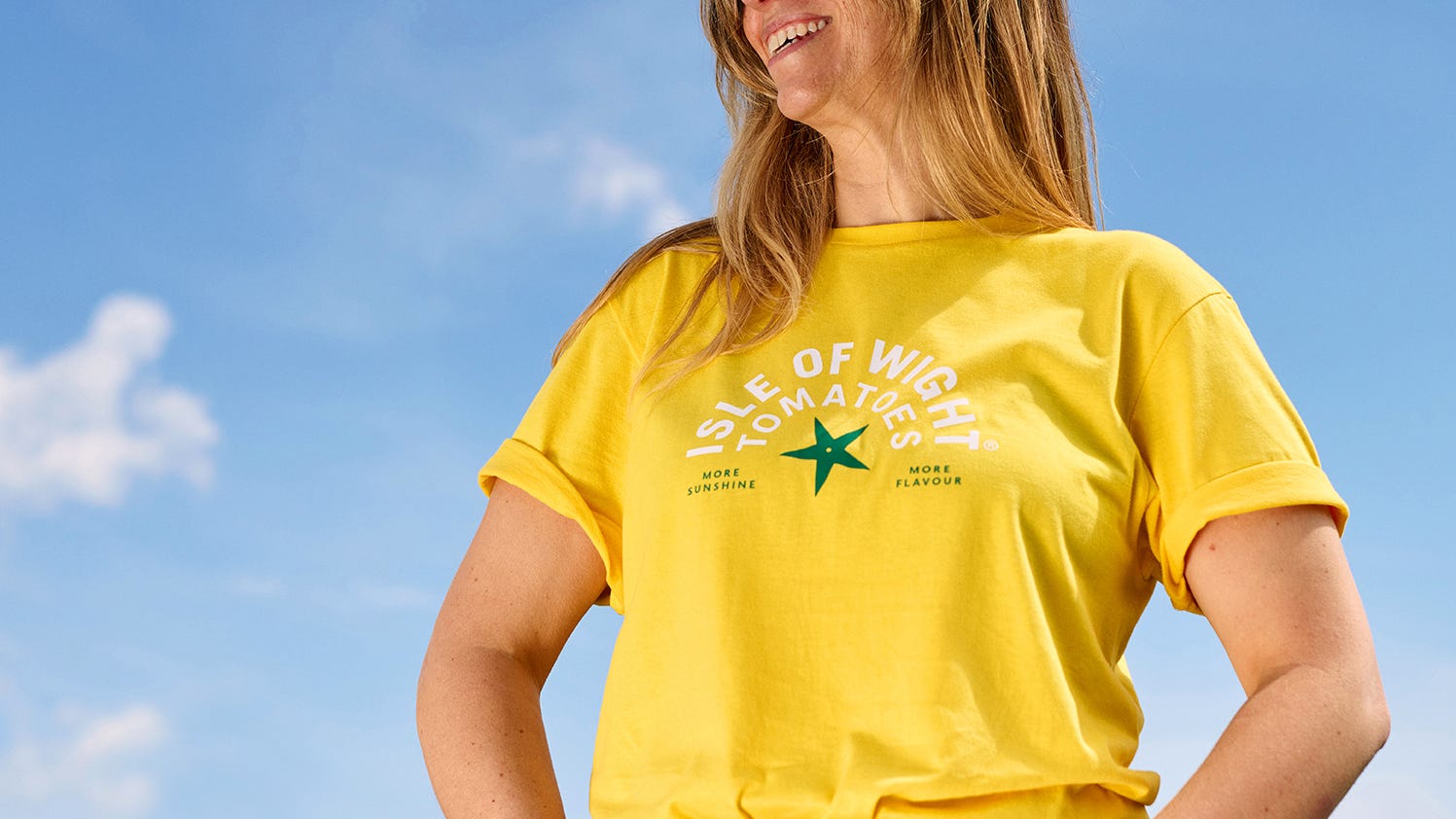
Isle of Wight Tomatoes used to be called The Tomato Stall. Fine name. Completely invisible on shelf, because tomatoes were a commodity and consumer engagement with branded tomatoes in the UK was essentially zero. In 2023 they did something risky, they made the place the name. The whole identity built around one product promise, More Sunshine, More Flavour, because the Isle of Wight gets more sunshine hours than anywhere else in the UK. That’s verified Met Office data, and a brilliant provenance-led brand truth, a meteorological fact the brand gets to borrow.
Post this provenance-led rebrand, year-one growth up 45%. British Airways catering. Wimbledon. Export markets in the UAE, where the brand doubled sales in its first full year at Spinneys.
Weetabix is another interesting example because it’s complicated. All Weetabix Original wheat is sourced within 50 miles of the mills in Burton Latimer, Northamptonshire, a commitment they’re serious enough about to have campaigned for the land to be recognised as its own county “Weetabixshire.” Over 350 farmers participate in the scheme, growing 75,000 metric tonnes of wheat annually. This is an example of a mass-market brand turning its supply chain into a provenance story. Pretty strong proof against the argument that hyper-local is only for farm shops and delis.
There’s a version of this hyper-local led branding that makes it easy to dismiss, anything that just slaps the Union Jack on pack “Made with Great British (insert ingredient).” Turn the pack over and discover that ingredient was sourced from wherever and wherever was cheapest that quarter. A Which? investigation in 2024 found Aldi selling bacon and cheese wraps with a Union Jack and "Made in Britain" on the front, pork from the EU on the back. At the same Aldi, tomatoes from Morocco, parsley from Italy and sweet mini peppers from Spain sat beneath a large banner reading "Championing Great British Quality."


Consumers in FMCG are increasingly forensic. They will look. If the story on the front doesn’t match what’s actually happening, you end up with a serious credibility problem you can’t easily undo. This is why it needs to be rooted in truth.
A bit of balance
"British" itself isn't cancelled. Internationally, it still pulls. Barbour, Burberry, Land Rover, Scotch whisky…the mythology holds at a distance in Tokyo and Dubai in a way it doesn't quite anymore in Birmingham or Leeds. Distance does something flattering to a complicated identity, the specifics blur into something coherent. Up close, at home, it falls apart.
A caveat here, geography is only as good as the story attached to it. Place names alone are not a brand strategy. Imagine someone told you they’d bought a whisky made in Scunthorpe. The word does nothing for you, regardless of how good the liquid is. But give that whisky a real history, a named distiller, a specific grain from a specific field, and suddenly it’s a different conversation entirely.
Domestically in 2026, the “British” label is running out of room. Too contested to be comfortable. Too vague to be meaningful. I am not saying that "British" should be binned, just that "British" on its own isn't pulling its weight anymore. Consumers in 2026 are tracking supply chains, reading the back of pack, and Googling the farm. A vague national claim means they have more to search for and less to trust.
The brands winning on British shelves right now are saying exactly where they’re from, exactly who made it, and exactly why that place matters to what’s inside the packet. Not saying British.