

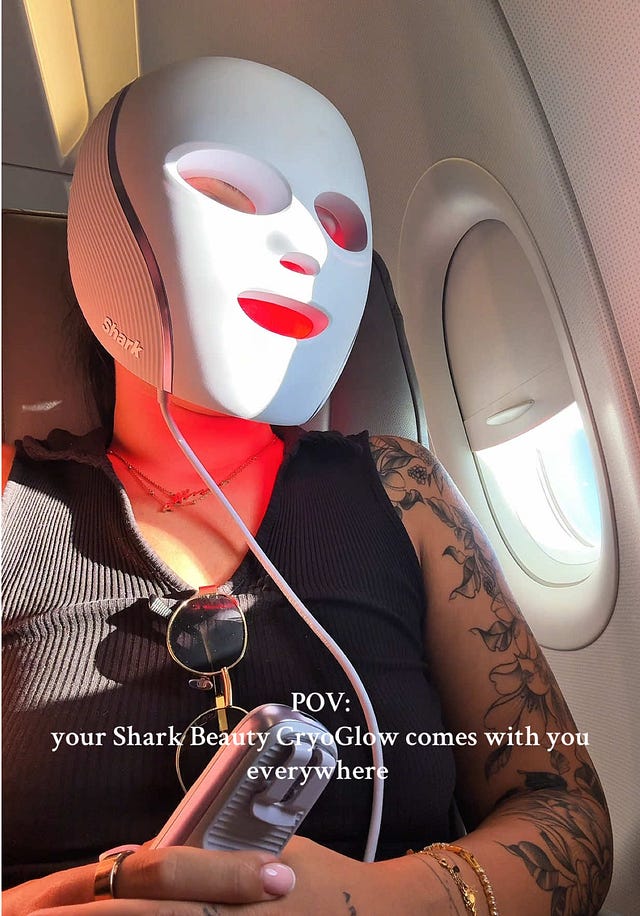
Earlier this year I was on a flight to the US and the woman in the row next to me wore a red light mask for the first twenty minutes. Glowing. Silent. Totally unbothered.
This is not a unique experience. I’ve seen videos of women wearing them on the Tube, or in their cars on their lunch breaks, scaring their boyfriends in the evenings. There’s a whole trend of it on TikTok.
 Tiktok failed to load.
Enable 3rd party cookies or use another browser
A decade ago, being seen trying would have been mortifying. The early 2000s ran entirely on the premise that beautiful women were just born that way, skinny, hairless, clear-skinned, effortless. Admitting to liposuction or a 12-step routine was social death. Any effort to be hot, was kept secret. Now we watch them transform on our screens, their effort is our content.
Something fundamental has changed in what beauty is for, but also our attitude to it. We are high-maintenance in order to appear low-maintenance, and we are no longer pretending otherwise, because we are all filming it for content.
How we got here
It started with YouTube. In the late 2000s, Get Ready With Me routines turned a private ritual into daily vlogs, for the first time, you were watching someone do their actual skincare in real time, chatty, unedited, and everything on their shelf visible. Packaging shifted to keep up, designed for visibility on camera as much as for performance on skin.
Then TikTok arrived and turned the dial up entirely. Now it’s come-with-me-to-get-a-salmon-sperm-facial. The consultation, the recovery bruising, the hospital gown, everything is content. This is, I think, a direct reaction to the opacity of the mid-2000s influencer era, the just-drink-this-flat-tummy-tea-and-you-can-look-like-me years. There’s an appetite now for tangible, visible effort. Proof of work. We are all optimising our beauty in public, and optimisation, it turns out, doesn't stop at the surface.
Your bathroom says more about you than your wardrobe does
In Highsnobiety’s Status Economy Beauty report, they said that 73% of Cultural Pioneers would agree that their bathroom cabinet tells a story about who they are.
I think this shows that our bathroom shelves have become a statement of our values.
Think about what’s actually on those shelves now. Niacinamide next to magnesium next to Trip gummies next to a Whoop band charging on the counter. A water flosser. A jade roller you use maybe twice a week. None of these things are makeup, but they are all beauty now. The silo between health and beauty has collapsed.
Jessica DeFino, beauty reporter and critic, puts it well “Beauty has taken over a space that was previously occupied by an ‘it bag’ or logo mania.” The bathroom shelf is doing exactly what the designer handbag used to do, it’s broadcasting your cultural class.
63% of people also say they’ve bonded with someone over a beauty product or reference, almost like a secret handshake. Your knowledge of which retinol is worth it, which brand sold out before anyone heard of it, which supplement stack is best backed by science, are all subcultural shorthand. Your beauty stack is how you prove you speak the language.
Beauty stopped being about the final result
Or rather, the result still matters enormously, but it’s no longer the only motivator.
Beauty used to be about expressing this is who I am. Beauty now says, this is who I’m becoming. The language has shifted with it. Looksmaxxing. Morning shed. Tweakments. All of it is rooted in small, continuous transformation, and not a fixed expression of identity.
And that logic has now crept inside the products themselves.
Maybelline’s Super Stay Skin Tint has “with Vitamin C” in the product name. bareMinerals sells a Strength & Length Serum-Infused Mascara, clinically tested over eight weeks, with peptides designed to grow your lashes while you wear it. Lashology, a UK brand, is literally a lash growth serum housed inside a mascara. L’Oréal Paris sells a Telescopic Lift Mascara alongside a companion Lash Serum Solution as a two-product daily system.
The silo between makeup and skincare has dissolved. The product that used to be purely cosmetic, cover it up, look good right now, is now being asked to treat while it performs. Foundation that brightens over time. Mascara that grows your lashes over eight weeks. It’s the same shift as functional drinks, it should taste good and do good. It should look good, and do good.
Which brings us back to the mask.
Jessica DeFino says “The red light mask encompasses all of what beauty means today: it’s tech, anti-ageing, a display of wealth... it’s about the products you wear to show you’re putting in the work.”
That’s why it gets worn in public. It’s a declaration. “I am culturally savvy enough that I can afford to be this committed to self-improvement, visibly, on a Tuesday morning flight to JFK.”
Beauty brands are now competing with your gym membership
The beauty shelf doesn’t stop at your face. Beauty is now a whole-body project. Skin, hair, nails, gut, sleep, mood, muscle. Every cell, optimised
Skincare bleeds into supplementation. Fragrance into mood regulation. The Ordinary sits next to AG1 sits next to your Oura ring. Beauty now includes what you whisk into your smoothie, what you laser into your deep tissue, what you inject, stack, and track. Creatine, GLP-1s, salmon sperm facials, and peptides. The whole body can be improved.
Lizi Aston, Global Communications at DECIEM, said “We’re seeing the traditional boundary between beauty and wellness disappearing. Consumers now see beauty as part of a broader wellness routine that includes nutrition, sleep, mental health, and fitness, and products are evolving accordingly.”
A McKinsey report said that 79% of UK consumers say wellness is a top priority. Gen Z and millennials buy more wellness product types per year than any older generation.
The result is that beauty brands are no longer only competing with other beauty brands. They’re competing with protein powder subscriptions, doctors’ offices, gym memberships, tracking apps, and tech companies. The beauty coin is split across a much wider spend, so you’d better be cutting through.
The proof is right there inside L’Oréal’s own results. La Roche-Posay, science-backed, system-first, a brand built entirely around process and proof, outperformed Maybelline in early 2025. L’Oréal itself described the makeup market as “weak, notably in the US,” and launched an emergency innovation plan to try to stimulate it. Same parent company, same budget, same distribution, different cultural currency.
The consumer wants to be in on the process. They want to see the science, they want a routine they can perform, and a shelf that’s worth showing. They want the cultural capital that an intelligent beauty routine can afford them. The brands winning right now are the ones with clarity. The Ordinary. Momentous. Oura. You know what they’re for, why they work, and how they slot into a daily system.
Beauty brands are losing market share to a creatine subscription, or a Whoop band, or a Pilates studio that does its own merch. The category has expanded.
That’s the new brand currency, being able to show you are optimising in public. Selling a ritual someone can perform in front of a camera, which shows that they are in the know.
Highsnobiety puts it directly, “maybe your next product isn’t a product at all, but a routine people want to follow.” Maybe think less about campaigns, and more about how your brand lives in someone’s daily system.
I’d go further. Maybe the brands that survive the next decade of beauty won’t only be selling products, they’ll be selling membership to a system. Or even a full-stack, holistic approach, vitamins sold with your personalised skincare. They will be selling a legible daily act of self-improvement with enough cultural fluency to earn a place on the shelf, and enough visual interest to earn a place in their content.
Ask yourself honestly. If someone filmed their morning routine tomorrow and your product appeared on the shelf, would it say something interesting about them? Would it signal that they are culturally savvy? Would it hold its own next to the AG1 and the Oura ring and the magnesium?