
It has been hot enough these last few weeks that I keep thinking about that bit in Airplane! where the sweat is just pouring off him. You know the one. It is the visual comic shorthand for “this is going badly,” and it works because sweat is funny, on men, in films, at a safe distance.

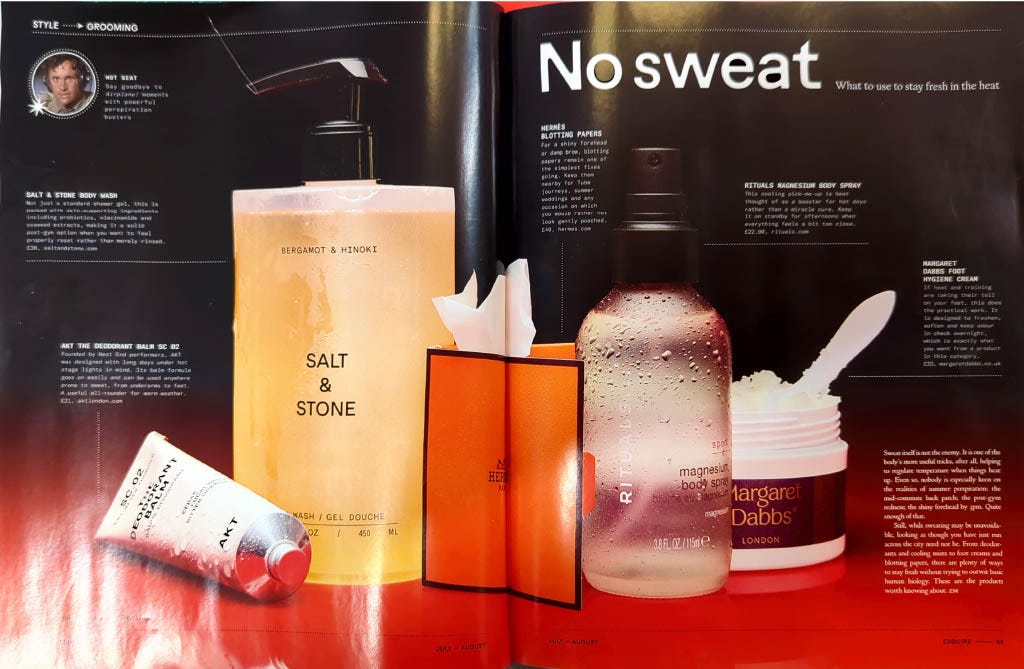
So it was a small joy to pick up an Esquire on the way into the studio (print’s not dead) and find that exact still wheeled out in a grooming spread about sweating less over the summer. Someone in that art department had the same heatwave brain as me. What stopped me was where it sat. A few pages earlier, the same issue was flogging a Prada skipping rope for over a thousand pounds, and Man Ray inspired Saint Laurent dumbbells. This is luxury’s idea of sweat. Beautifully lit, very expensive, and artful, if faintly embarrassed about itself.


Every call to action across the anti-sweat pages was about not being caught out. Avoiding “the mid-commute back patch”, the post-gym redness, “the shiny forehead by 3pm”. The blotting papers, a snip at forty quid from Hermès, are there for “any occasion on which you would rather not look gently poached”. Beautiful line. However, you can see what it is doing. Nothing on these pages sells you a better version of yourself. It sells you the absence of an embarrassing one.
What I really noticed was the difference, as an avid reader of Grazia, the contrast was stark. Women’s beauty sells the upside. Glow, radiance, plump, firm, sculpt. Men’s grooming sells the downside removal. Don’t smell, don’t shine, don’t be the sweaty one in the meeting. Luxury men’s skincare is a subtraction category, and the language is where you can see it most clearly.
In the copy, every product in that spread is about something other than how you look. The AKT deodorant balm was “designed with long days under hot stage lights in mind.” That reframes your sweat as an occupational hazard rather than a personal issue. The Margaret Dabbs product is a foot hygiene cream, not a foot care cream, and it is all about heat and “training” taking their toll. You don’t smell because your feet smell. You smell because you train. Very manly. Not one of them is justified by saying this will make you look good. The most they will risk is this will stop you looking bad.
Prestige grooming has tiptoed around skincare for men for decades, terrified of sounding feminine. Shaving became the one ritual you could safely hang everything else off, the manly Trojan horse for a moisturiser. The early-2000s vocabulary was razor relief, oil control, cooling gel, pure utility. The 2020s version talks about energising, restoring, focus. Care for men finally got an emotive vocabulary, it is just that the feelings still have to route through ambition and performance, never anything as soft as wanting to look nice.
The avoidance is seen in the size of ranges as well as linguistically. Jared Holst observed that Clinique's "for men" range offers four areas, shave, cleanse, moisturise and a vague "targeted solutions". Switch to the side of the site that isn't labelled for men and you get twelve categories, eight skin concerns and five different formats. There are more concerns listed for women than there are whole categories for men.
It tells women they need far more products than they actually do and simultaneously gives men the option to limit how much time, effort, and money they have to spend on skincare.
Given all this, and assuming both men and women have equally nuanced skincare needs, it feels safe to assume many of the products marketed to women are unnecessary.
Perhaps women’s luxury skincare could learn from this, rather than leaning into women’s skincare products that use jargon, insecurity, and hyper-specification to make sure they are picked up off the shelf; they could look at language that emulates the men’s ranges. Maybe even a luxury range that only offers four types of product. We can only dream. However, I think a brand that did do this, translated this language to a woman-focused brand, there could be a real opportunity.