

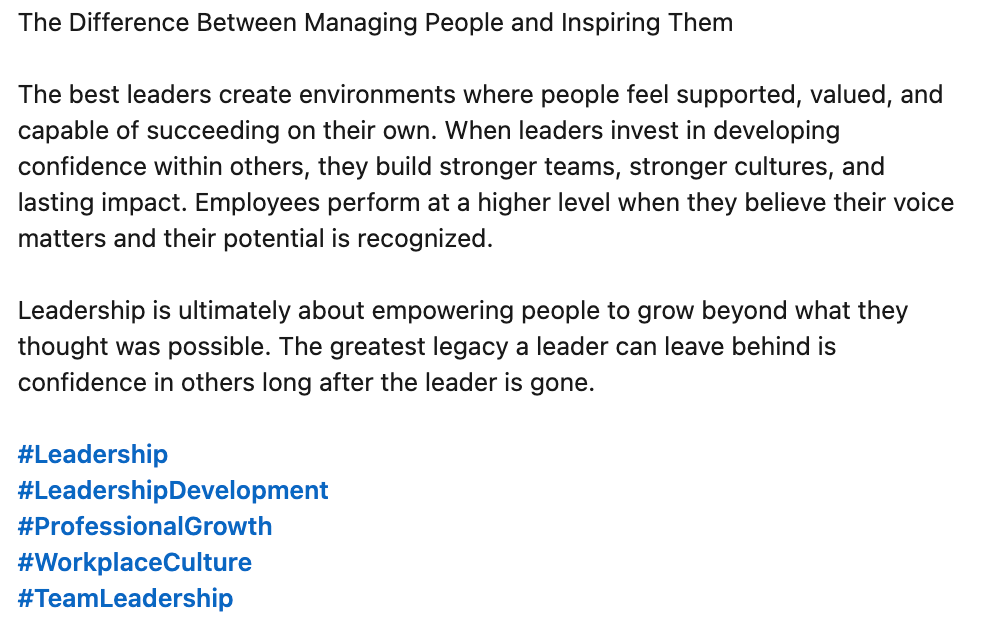
Everyone seems to be a thought leader now. Your LinkedIn feed is full of tepid takes that 47 other people posted yesterday, usually something groundbreaking like “if you’re a leader, be nice”, or AI slop, or my favourite, a cringy low-res quote about leadership.
There’s a lot of content being put out at all times. We see frameworks, recycled LinkedIn advice, and people announcing they’re “excited to share” something. They all call themselves “thought leaders”. In truth, they get very little engagement, and worse still, their content is dull.
As a corporate company, you’re consistently told that your leaders need to be “thought leaders”, so in an effort to fill the void, thought leadership became a content marketing tactic.
It’s funny that the word “leadership” is used because it’s usually just best practices presented as an innovative approach, or hot takes designed to be as inoffensive as possible, basically the business equivalent of horoscopes. Vague enough to feel relevant to everyone, but you definitely can’t come after them with specifics.
As of May 2026, LinkedIn has had enough. The platform announced it's now actively suppressing posts and comments it flags as low-effort AI-generated content, what they're calling "AI slop." Posts won't be removed, but they'll be pushed out of recommendations and away from anyone outside your immediate network. They say their detection system correctly identifies generic AI-generated content 94% of the time. Ironically, they're using AI to clean up the mess that AI created. The message, even if politely worded, is “stop letting AI do all the thinking for you”.
This is for the best, we know that bad thought leadership might be actively harming your brand.
Nearly three-quarters of decision-makers say an organisation's thought leadership is a more trustworthy basis for assessing its capabilities than its marketing materials. So if it's poor, it reflects badly on everything else you put out. Currently, less than half of decision makers say the overall quality of the thought leadership they read is good, and only 15% describe it as very good or excellent.
Once a brand is perceived as producing marketing disguised as thought leadership, trust recovery takes a long time and could need a complete voice or strategy realignment. You can accidentally slowly contaminate your entire brand with bad or lazy content.
There’s also a group of people influencing your deals that you probably aren’t thinking about. LinkedIn calls them “hidden buyers”, the finance, legal, compliance, and procurement stakeholders who sit inside buying groups and have just as much sway over a final purchase decision as the person you’re pitching to. More than 40% of B2B deals stall because of internal misalignment, and hidden buyers are a major reason why. They’re reading your content, 64% spend over an hour a week on thought leadership, however, many of them report little or no interaction with sales. Hidden buyers want content that challenges their assumptions rather than validates what they already think. Safe, hedged, inoffensive-but-dull content doesn’t reach them, you just add to the noise they’ve already learned to filter out.
Additionally, when everyone publishes the same safe takes, you become interchangeable in buyers’ minds. Your content becomes extra fluff and noise rather than a differentiator. Price becomes the deciding factor because there’s no intellectual differentiation, so it becomes a race to the bottom.
Anxious to publish, Anxious to not
B2B clients feel pressure from above to maintain thought leadership to stay relevant. Competitors are publishing whitepapers. The CEO should have a POV, but what should it be? There’s fear of saying nothing versus fear of saying something wrong.
What if the risk of being wrong is outweighed by never having an opinion?
60% of decision-makers say good thought leadership makes them willing to pay a premium to work with that organisation. The risk is actually in being bland.
Now LinkedIn's algorithm has formalised that risk. Content creation on the platform is up 14% year on year. The volume of noise is growing. If you're not saying something real, based in truth, or on your own knowledge or research, you're not saying anything, and soon you'll be algorithmically invisible too.
Every piece of forgettable thought leadership is building the wrong brand associations. You end up anchoring the impression that you, or your company, is risk-averse, derivative, self-serving and, worst of all, boring.
What does good look like?
If you want to understand what good actually looks like, start with the people who are doing it best.
Mark Ritson is (frustratingly) worth reading, partly because he doesn’t care if you disagree with him. His Marketing Week column reads kind of like someone who has run out of patience with the industry and decided the most helpful thing he could do was speak straight. He backs everything with evidence, and he’ll call out a brand for doing something stupid even if everyone else is applauding it.
Sophie Miller, who founded Pretty Little Marketer, is worth following, she writes about social media, community, and how to build a following. Her thought leadership is brimming with personality, and she's also a live demonstration of everything this article argues for. Over 600,000 people follow her because she's specific, because she shares the behind-the-scenes, and because she shares her proof points. On a platform increasingly full of people talking about authenticity without being particularly authentic, she's one of the few.
Ana Andjelic writes The Sociology of Business on Substack and approaches brand from a cultural theory angle rather than exclusively a marketing one. She writes about status, taste, aspiration, and what happens when brands try to manufacture things that can only be earned. If you work with challenger brands or anything in the premium space, she’s probably the most useful person on this list. Her thought leadership is clean, concise and well visualised.
Then there’s Matt Kilb, KISS co-founder, who writes a weekly newsletter on LinkedIn doing exactly what this article argues for. Real observations from real client work. Specific. Opinionated. The practitioner’s view, from someone who is inside the work every week rather than commenting from a distance. Worth a follow, and I might be slightly biased, but honestly, the bias is warranted.
None of these examples are posting “be kind to your employees” or AI slop. Just writing, that sounds like them, based on their real expertise.
So, How to Do Thought Leadership well?
This is the checklist I use to write interesting thought leadership
Could this apply to literally any company? (Is it something really bland like “be kind to your employees”?)
Does it make anyone uncomfortable?
Would you implement these recommendations yourself?
If the answer is yes/no/no, try again.
You could also ask
Might this piss off at least 30% of your audience?
Is it a bit weird to say this in your industry?
Would your competitors disagree with this?
Where do I Start?
Start with what you’ve genuinely noticed, it’s where we usually start at KISS, is internal conversation. Stuff we’ve noticed and discussed. Stuff that gets us excited and we think will excite others in the industry.
Don’t ask “what’s our position on AI in marketing?” That’s how you get lukewarm takes. Instead, say “We’ve noticed clients who use AI for ideation, but not execution, get 3x better results. Here’s why AI-only campaigns are failing.” Far more interesting. Much more specific.
Secondly, just prove you’ve done the work. Show the behind-the-scenes. A generic thought leadership post would say “Brands should focus on customer experience.” Great. Cool. What’s new?
Showing the behind-the-scenes, you might say, “We analysed 247 customer service transcripts from our clients. 89% of escalations weren’t product problems, but were unclear pricing communication. Here’s the email template that reduced escalations by 64%.” Brilliant. Far more interesting and much more useful.
Finally, differentiate at the belief level. If you’re a consultancy, what consultancy orthodoxy do you reject? Maybe “Most consultancies optimise for billable hours, which slows client progress because it creates a perverse incentive. We charge fixed project fees because we want you to succeed fast.”
It’s a way to show how your belief system sets your brand apart from the category.
Long Live Thinking!
Your competitors are publishing thought leadership to look credible. They’re actually eroding trust with every bland take, and now LinkedIn is making that erosion algorithmically invisible.
There are people inside your prospective clients’ organisations, in legal, finance, or operations, who are invisibly reading your posts, forming opinions, and will never take your call. Your thought leadership might be the only conversation you get to have with them.
Great round up.