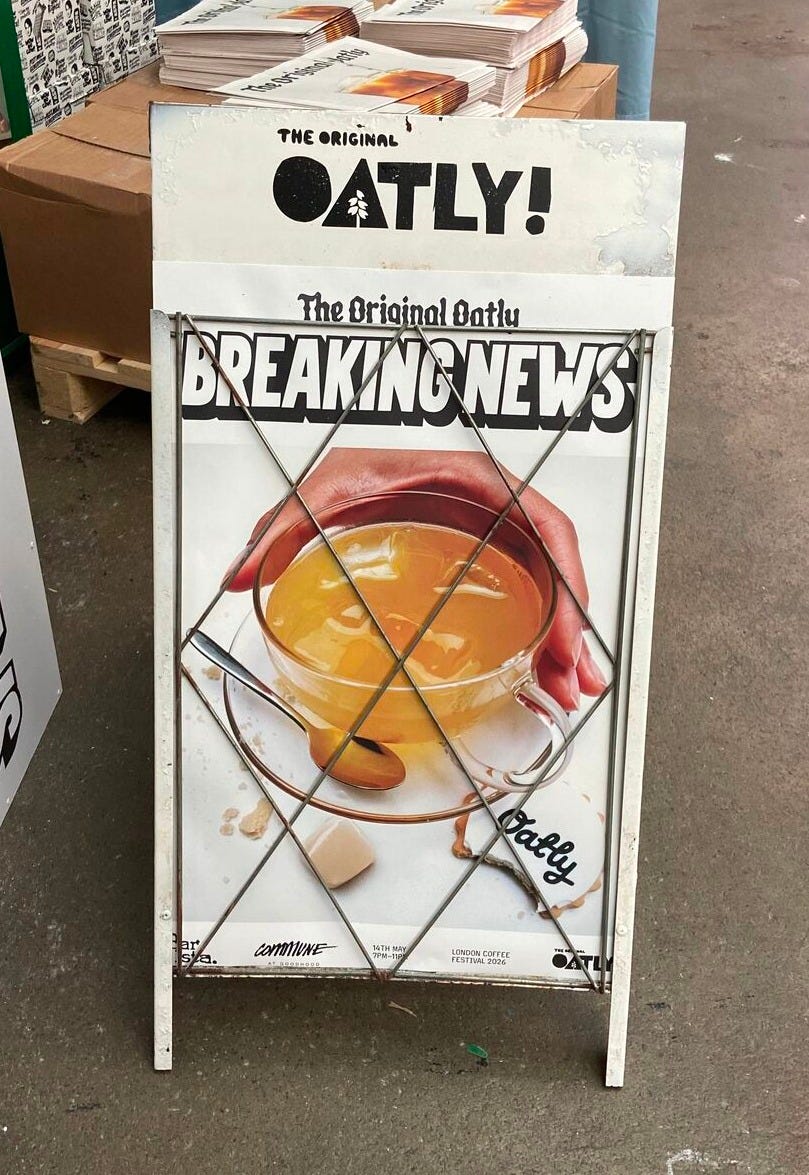

Last week I was at the fantastic Northern Design Festival, which also means I was watching the London Coffee Festival unfold on LinkedIn from a distance, which is its own kind of joy. Oatly had a stand. And while Oatly always has a stand, this one was different.
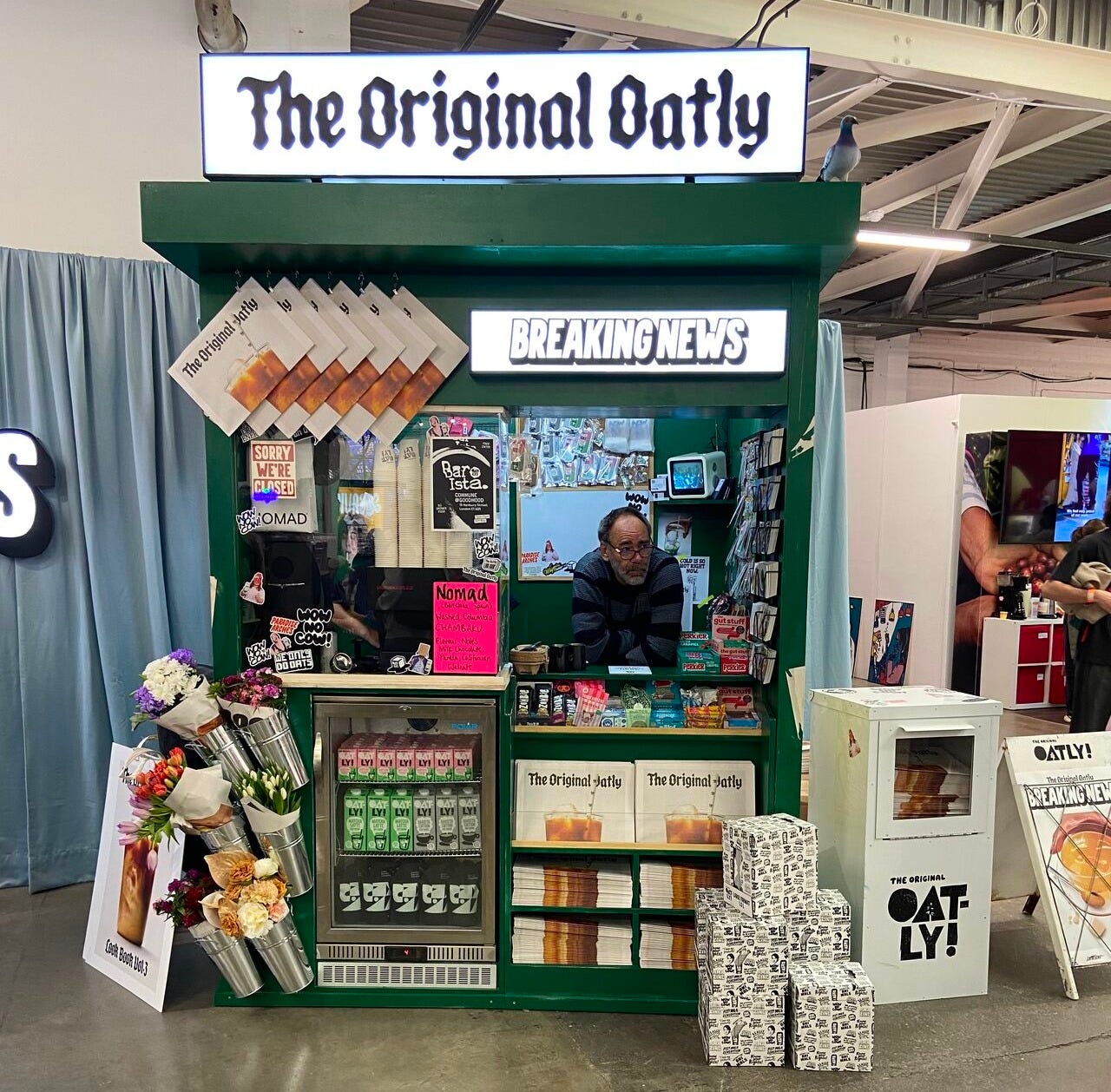
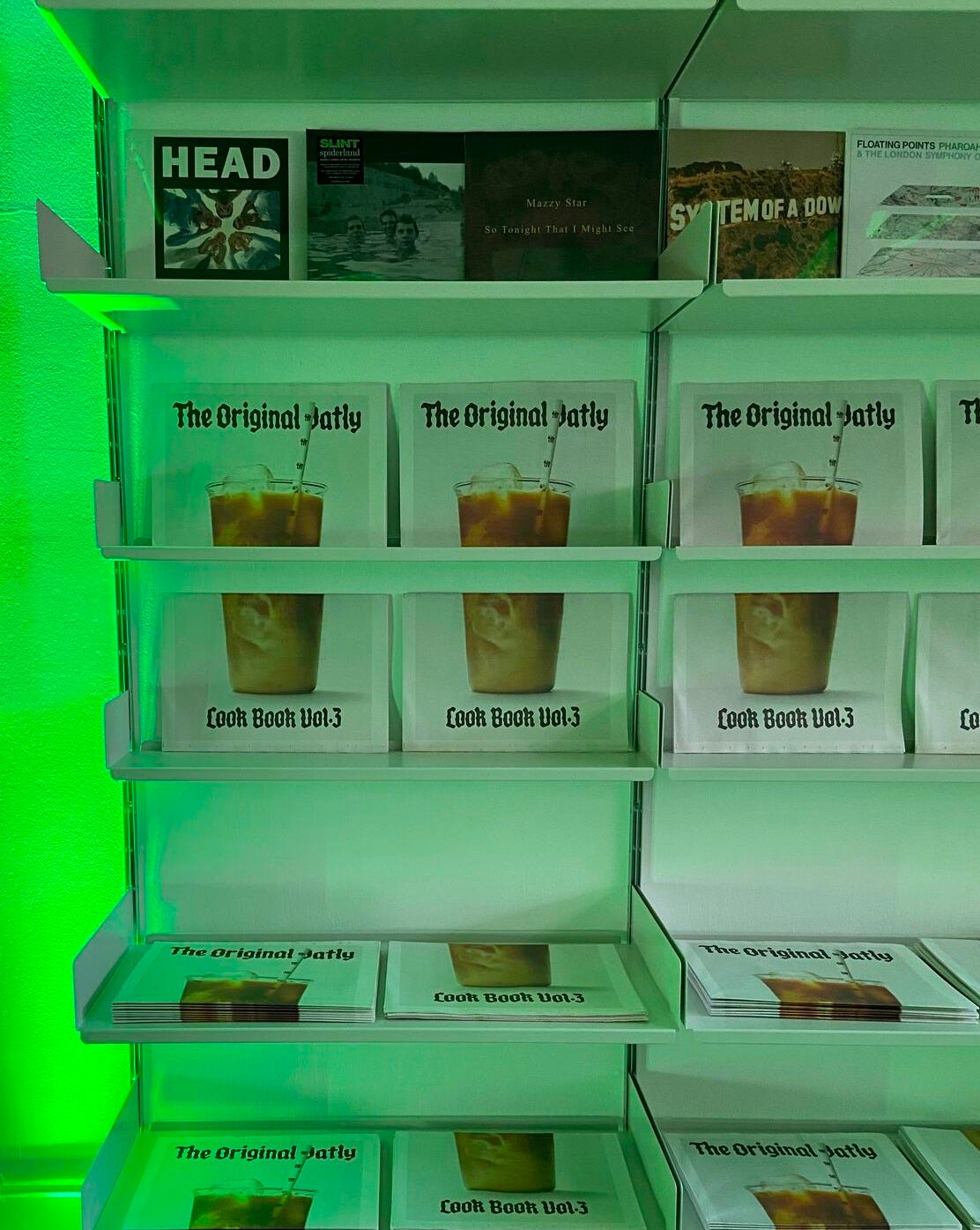
It was framed as a news kiosk. “The Original Oatly. Breaking News.” They had thought of all the touchpoints. A deliberately grumpy news stand man. Flowers wrapped in Oatly newspaper print, sold by feYi from stainless steel buckets. A sushi conveyor belt running drinks, Papaya & Basil Seed Smoothies, Teas & Black Sugar, Origin Burnt Lemon Cold Brew Tonics, Matcha Jell-Oat Shots on branded silver plates. And alongside all of that, Look Book Vol.3, a proper editorial newspaper shot fantastically by Dead Hungry, displayed on shelves under a fantastically curated vinyl selection. Slint. Mazzy Star. System of a Down. Floating Points and the LSO. The world-building was brilliant. However, this feels like a grown-up version of the oatly I remember. More culturally savvy, more fun.


I saw the post from Rob Godfrey, Head of Brand UK&I, who confirmed the whole thing was built in-house by Oatly’s Department of Mind Control. I cheekily asked if they’d post us a of their new lookbook, and they sent two, and six 1.5-litre bottles, and two cases of their new RTD Barista Iced Macchiato and Iced Flat White. Incredibly kind, very delicious.


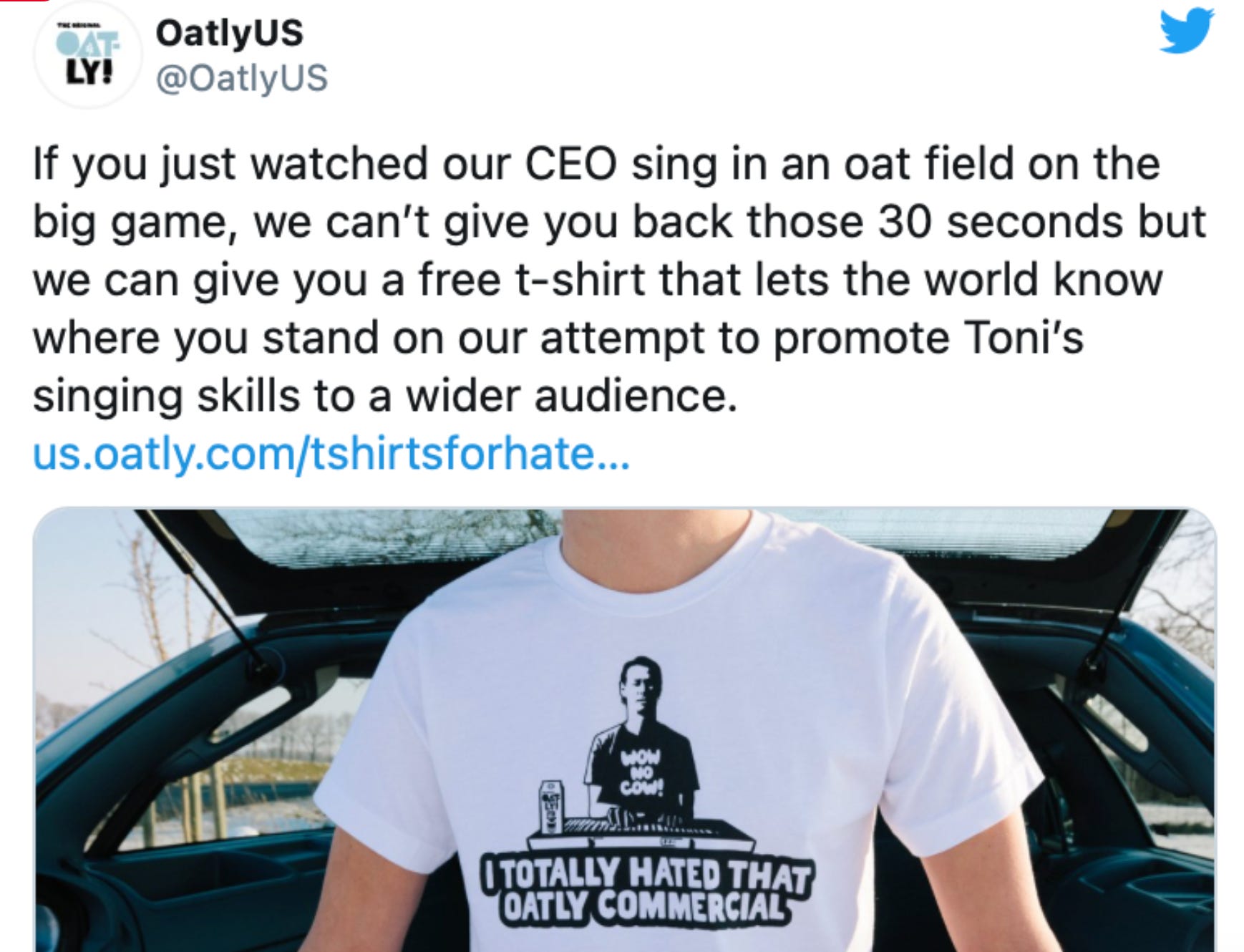
But here’s what I actually can’t stop thinking about. This isn’t the Oatly of 2015. It isn’t the clap-back tweets, or the intentionally cringe Super Bowl ad where CEO Toni Petersson sits alone in a field singing off-key to a keyboard (although that is still one of my all-time favourite ads). This is more confident. More culturally fluent. Still completely, unmistakably Oatly, but just evolved into a mainstream brand.
So how? How does a challenger brand grow up without losing, or becoming, the thing they challenged in the first place?
Real challenger brands don’t really sell products. They sell opposition. The enemy is the centre of the brand, it creates the tension, the voice, the sense of community around a shared point of view. Without a villain, there’s no story, and without a story, there’s no soul. This is the mechanic of a challenger brand ethos. So how do you pick the right enemy? Well, there are two kinds.
The category enemy is the first one. Big dairy. Faceless corporate conglomerates. Beige lager. It works brilliantly at launch, consumers get it immediately, and it’s a simple rallying cry. The problem is that category enemies have a shelf life. You win, you get bought, or your enemy disappears. When any of those things happen, so does the core brand.
Wild was founded in 2019 with one very clear enemy: the single-use plastic deodorant industry. Refillable cases, plant-based formulas, zero waste, the brand built a loyal following of exactly the kind of consumer who would check a company’s supply chain before buying. In April 2025, Unilever acquired them for £230m. The same Unilever that owns Sure, Lynx, and Dove, the mass-market, conventional deodorant brands that Wild was created in direct opposition to. Independent co-shops dropped the brand within days. Eco-conscious customers announced they were switching. Wild’s own community had spent years buying into an identity that was, at its core, about being an independent. The enemy had literally become the parent company.
There’s also Ben and Jerry’s who built their entire brand on the idea of ice cream with a conscience. Unilever acquired them in 2000 with promises of independence. In September 2025, co-founder Jerry Greenfield quit after 47 years. “Standing up for the values of justice, equity, and our shared humanity has never been more important,” he said, “and yet Ben and Jerry’s has been silenced, sidelined.” The enemy had broken down the brand from the inside.
Both had category enemies. Both found category enemies have a shelf life.
So the other type of enemy is systemic enemies. Oatly’s enemy could have just been dairy brands, but it really has become the industrial food system.
Oatly was founded in 1994 off the back of research at Lund University and spent the next nearly two decades going more or less nowhere. Then in 2012, Toni Petersson arrived as CEO. He brought in John Schoolcraft as creative director, abolished the marketing department, and replaced it with something they called the Department of Mind Control. They redesigned the packaging “to feel like it was made in a basement” He put his personal email on the carton and promised to write a poem for any customer who didn’t like the product.
![oatly | EBC: Ewha [Brand Communication]](https://substackcdn.com/image/fetch/$s_!uiIF!,f_auto,q_auto:good,fl_progressive:steep/https%3A%2F%2Fsubstack-post-media.s3.amazonaws.com%2Fpublic%2Fimages%2Fa7c41f54-2165-47df-98b4-5db7f1c1e779_1024x512.png "oatly | EBC: Ewha [Brand Communication]")
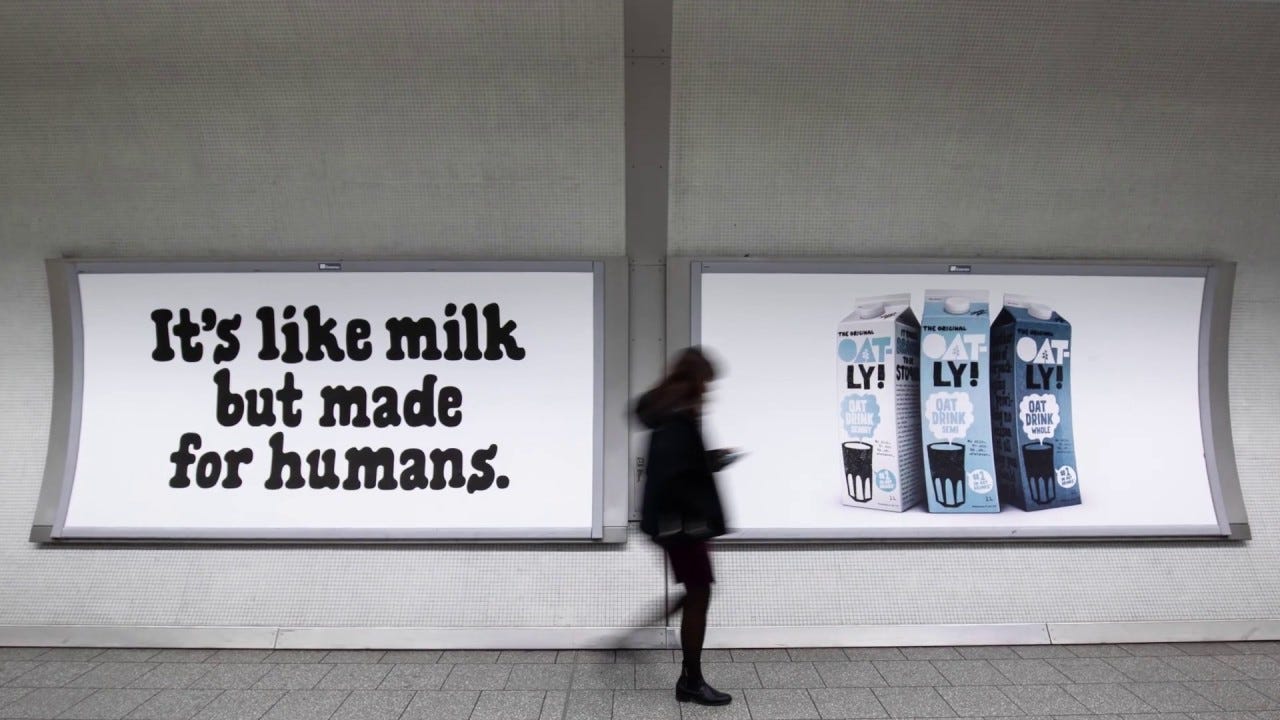
They claimed, “It’s like milk, but made for humans.” The Swedish dairy lobby, an industry body with 200 times Oatly’s revenue at the time, filed a 174-page lawsuit in 2015. So, Oatly published it in full. Their enemy handed them their best PR for free.
They printed their carbon footprint on the front of every pack and publicly challenged every other brand to do the same. They ran a campaign called “Food Industry, Show Us Your Numbers.”In June 2024, they became the first food and beverage company recognised as a “Climate Solutions Company.”
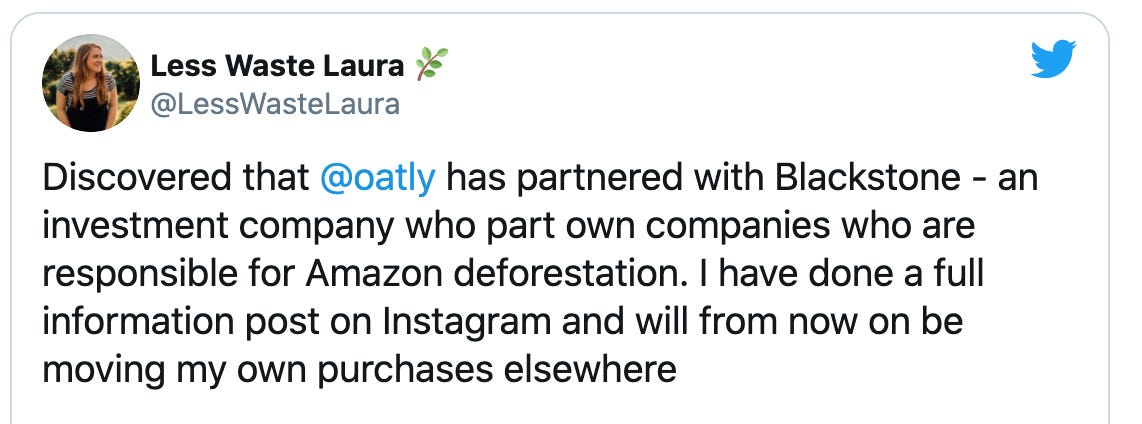
However, when Oatly took £200m from a Blackstone-led investment group in 2020 (Blackstone being linked to Amazon deforestation, its CEO having donated $3m to a pro-Trump super PAC) former fans called for boycotts. Oatly built a website. FckOatly.com catalogued every controversy the brand had ever faced, the Blackstone deal, the Glebe Farm lawsuit, the TikTok furore over their ingredients list, all of it in one place. "It's super convenient to have the latest boycotts and criticisms all in one place," they wrote. "We're not the type of company to hide from moments like these. We see all the negative headlines, posts and petitions as an inevitable consequence of trying to create positive societal change." The site got 300,000 visits in seven months.
Back to the news stand. Look Book Vol.3 under Slint’s Spiderland.
Oatly’s revenues hit $862m in 2025, up from $824m the year before, and they delivered their first-ever full year of profitability as a public company. The stock is still down 94% from its IPO peak, the operational years were rough, a supply chain disaster that cost them badly, but the brand never changed on its main mission.
New CEO Jean-Christophe Flatin, who came in from Mars in 2023, calls the current period a “recalibration.” The Department of Mind Control still runs all creative in-house. The social strategy still has two rules: be consistently inconsistent, and never bore people.
What I noticed in those photos from the London Coffee Festival is that this feels like a brand stepping into a second era of cultural confidence. There’s a real difference between irony as self-deprecation, the basement packaging, the cringe Super Bowl bad singing advert, and irony as authority. The news stand, the editorial lookbook, and the curated vinyl are no longer scrappy and fighting, this is an elevated, thoughtful, and artistic version of the brand.
The Wilds and Brewdogs of the world scaled the business and lost the brand. Oatly levelled up the touchpoints and has come back to protect the soul. The reason, I think, is simple: when your enemy is systemic, the brand is the mission. You cannot accidentally grow out of it.
The longevity of a challenger brand comes down, almost entirely, to which enemy you pick on day one. Category enemies have a ceiling. Systemic enemies scale with you. So, the question every founder should ask is, if we win, through scale, through becoming mainstream, does our enemy still exist? Is there still a reason to choose us?