


When a scaling or legacy food and beverage business hits a growth plateau, faces a cultural shift, or starts sweating over a retail expansion, they look to marketing to fix it. Sometimes, this arrives in the form of a loud co-branded gimmick designed to manufacture instant buzz.
To be clear, collaborations aren’t inherently bad. When two brands with genuinely aligned audiences collide, it can be ace. Look at Candy Kittens teaming up with Little Moons for a limited-edition Sour Watermelon mochi ball, both have fiercely engaged fanbases, vibrant visual worlds, and a shared sweet-treat DNA.

The ones I dislike are chaotic co-branded stunts, like Cheez-It x Coors Light Beer Cheese crackers, or the lingering fever dream of Krispy Kreme x Crocs. They aren’t natural bedfellows, it just feels like being quirky for the sake of it. From a brand building perspective, these dilute the brand.


So what separates the good from the gimmick? Before you start mocking up packaging, run the idea through two quick questions. Firstly, do the two audiences genuinely overlap? Good collaborations bring two natural communities together over shared taste or values. Bad ones are just an expensive shortcut to borrow another brand's followers for a short period.
Secondly, would the product make sense if neither logo were on it? If you stripped away both brand logos would the flavour combination or product actually be desirable on its own merits, or is the entire joke relying on two clashing trademarks sitting side by side? If not, hesitate!
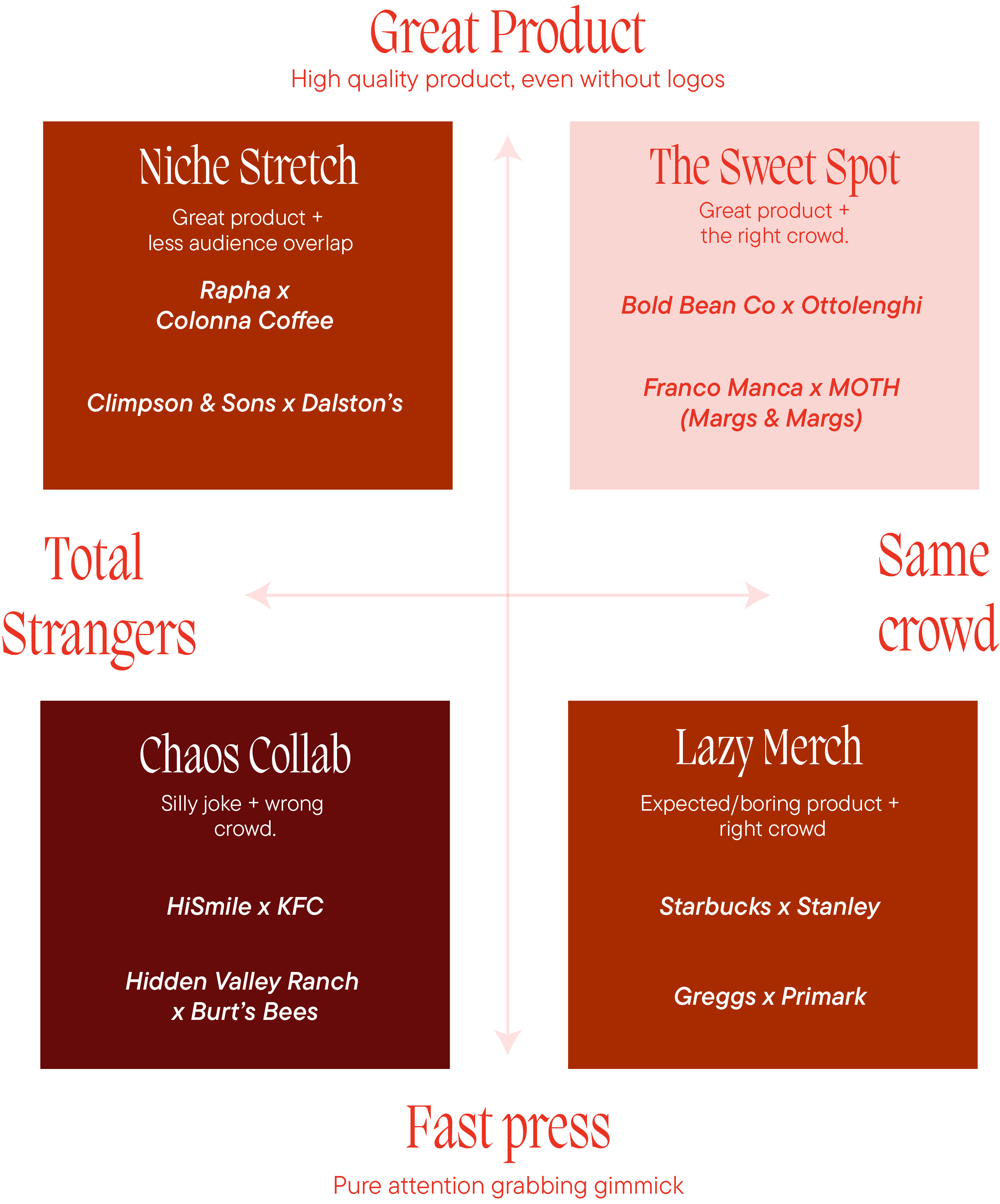


When established F&B brands face stagnating growth or retail buyer pressure, a collab of this nature can feel like a way of hitting targets with some instant press-hits. In reality, stunt collaborations are a sugar high that potentially masks a deeper positioning problem, market misalignment, or internal chaos. Additionally, the market is already fairly saturated, collaborations became one of food and drink’s most-used PR tactics in 2025, many built more for social media pickup than genuine appeal, and analysts are already warning of consumer burnout. Meanwhile, 80% of consumers say inconsistent brand messaging makes them question a brand’s credibility, which is exactly what a run of unrelated stunts creates. Every brand chasing the next viral trick leaves less space for the coherent brand equity that earns trust.
Viral stunts and lasting efficacy
Chaos partnerships are great at generating buzz for a minute. What they don’t do is create trust, repeat orders, or permanent shelf space.
Back in 2024, going viral was the ultimate goal, but in 2026, consumers (especially Gen Z) have firmly separated finding a brand on social from it having inherent brand trust. A Harris Poll earlier this year found 62% of Gen Z use TikTok to discover new products, yet 63% have stopped buying through TikTok Shop, and 60% trust the platform less than they used to. Discovery happens in the feed, but the decision to buy happens when AI tools and real humans verify what’s behind the label. As I wrote in Double Validation, 98% of consumers still verify a brand before parting with their cash. Just going viral is not equivalent to building brand equity and trust.
Additionally, in food and drink, the repeat purchase matters far more than the first one. 2026 e-commerce figures show F&B converts shoppers well, but people spend relatively little per order, and subscription churn is the highest of any category, with 28.2% of subscribers cancelling by their second or third delivery. So, shoppers will happily dip in at a promotional price to try something new, or weird, decide it’s not quite right for them, and never come back. Stunt collabs get people to click once out of curiosity, which is expensive, and it rarely leads to the regular repeat buying that makes winning a customer worth the investment. Money is also tight: 62% of consumers say cost is one of their biggest concerns, so shoppers and retailers are quick to ditch gimmicks that don’t earn their place.
A bad collaboration can also affect your relationship with your retail buyer. Yes, a quirky mashup might get you through the door. Buyers love a bit of theatre, and a loud stunt can be just enough to win you a trial listing. However, once you are on the shelf, buyers get judged on rate of sale (how many units move through the till every week), so if your gimmicky SKU doesn’t sell through quickly, it gets cut at the very next range review. It’s a competitive shelf as well, with only around one in three new FMCG launches across the UK and Europe reaching even 1% of households in 2025, and many that won a first purchase never earned a second.
A delisting can leave a mark on your reputation. When a buyer takes a risk on your “viral” launch and gets stuck with slow-moving stock, they’ll remember. Six months later, when you come back to pitch your sensible new flavour, that buyer is a lot more cautious, because they’ve stopped trusting your sales forecasts. So, when you are fighting to build a permanent retail footprint, one novelty flop can really set your buyer relationship back.
Positioning Before Execution
If your internal team is fractured, your portfolio lacks clarity, or a new product line isn’t landing with retail buyers, a stunt collaboration will only add to the noise. Worse still, great brands win by being instantly recognisable. Every off-brand stunt chips away at that clarity, making it harder for shoppers to remember what you actually stand for. One weird mashup won’t undo years of hard work, but a string of them leaves you known only for your last gimmick, which gives you a shaky foundation for whatever you launch next.
Before signing off your next collaborative launch, you should run your idea back through the two axes of the matrix at the top of this article:
Audit your positioning before chasing reach (Same Crowd). Can your leadership team articulate your core value clearly across every touchpoint? If you aren’t crystal clear on who you serve and why, borrowing someone else’s audience won’t fix it. Making sure your core customers genuinely overlap is key.
Build product depth before chasing press (Great Product). Strip away the logos and ask if the product earns its place on a tight weekly shop. Look for collaborations that deepen what you already stand for, like Bold Bean Co x Ottolenghi or Candy Kittens x Little Moons, rather than novelty mashups built for an always on news cycle.
The best collaborations reinforce your positioning and drive look-alike customers to your brand. Stop buying sugar highs, and start building a brand people actually want to buy twice.
I wonder how brands should evaluate collaborations when the immediate commercial results look positive but the long term effect on brand perception is less clear
Great breakdown — the repeat-sales point is spot on.