

Last Friday, Olivia Rodrigo dropped the video for “expectations” with Chappell Roan. Within a day, fans had freeze-framed a few wonky hands in the animated sequences and were calling it AI slop. Awkward, for an artist who had told The Hollywood Reporter weeks earlier that she would never use AI in her music.


Except it wasn’t AI. Her team posted the behind-the-scenes: hand-drawn illustration, 2D and 3D animation, played back on old screens and filmed for that retro texture. The wobbly fingers were a human’s wobbly fingers.
That’s the the current cultural era, synthetic suspicion, a bit of an AI witch hunt. Audiences now assume polished work is machine-made until proven otherwise, and even imperfect human work gets caught in the net.
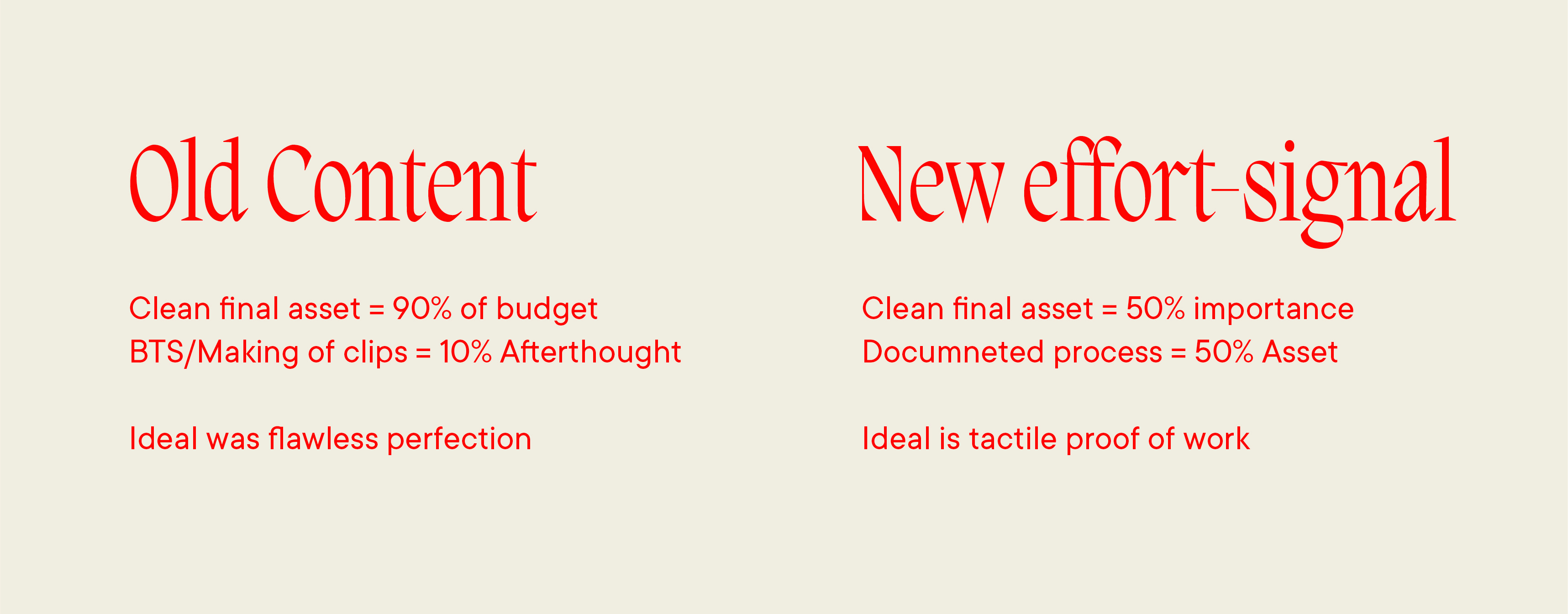
So, heres the trend. Behind-the-scenes (BTS) content can’t be bonus footage any longer. It has to be part of the campaign. This is what was coined as “Effort signalling” by the brilliant Miranda Shanahan, its the idea of showing physical, tactile, imperfect human proof of work, or simply physical man-hours, is now how brands earn trust and protect the value of their creative.
Too glossy and polished = distrust
Previously, polish meant money had been spent on the work. A slick TV spot or digital advert told you someone had paid for the crew, the set, the grade, and the retouch. The whole process was expensive, and as there was a cost barrier to who could execute this kind of work, that in itself was a sign of spend and quality.
That reasoning no longer exists. Generative tools have made high-end digital gloss close to free, and a sign that costs nothing signals nothing. Worse, it now almost says the opposite. Too glossy reads as synthetic.
Canva’s 2026 marketing report found 70% of people reckon they can usually spot an AI ad because it feels like it’s “missing its soul”. Yet in Getty Images’ global VisualGPS research, they found 76% actually can’t tell whether an image is real. Confident they can spot it, unable to actually tell. That’s the recipe for suspicion. People go looking for the tell in everything, and anything too smooth gets flagged, human-made or not.
We felt this with putting case studies out at Kiss. We put out glossy, carefully made launch films, and some of the first comments asked which AI tool we’d used. Hand-made human work, discounted in a sentence.

It’s a cousin of the “uncanny valley” which is a term from robotics. As something looks more human, we warm to it, until it gets almost right. That near-miss face, slightly too smooth, slightly off in the eyes, tips us from comfort into unease. Our trust drops off a cliff.
What’s happening with AI imagery is a cousin of that. Images that are too flawless now trigger the same reflex. Suspicion and unease that we are being hoodwinked.
The original pitch was a luxury finish on a budget. Oversupply has turned that finish into a giveaway for audiences.
Shortcuts and sh*t
Consumers don’t judge marketing in isolation, it’s a kind of value judgment, how a brand treats a 30-second film gets taken as a preview of how it treats the details, like stitching, or the ingredients, or even the customer.
Unfortunately with AI people associate it with shortcuts and laziness, so an ad that looks generated says '“we can only be bothered to spend ten seconds on you”. If they cut corners here, where else are they cutting them? A poll found 73% would trust an ad less if they suspected it was AI-made, and 63% would be less likely to buy from a brand using AI-generated ads.
This has also been reinforced due to the places we see it most often aren’t luxury at all, like dropshipping ads, takeaway menus, or scammy sponsored posts. The glossy AI look now lives in the bargain bin, so it reads as cheap.
It’s not just what people say, either. NielsenIQ’s neuroscience testing found AI-generated ads, even the high-quality ones, triggered weaker memory activation than traditional ads. Less trusted and less remembered, that’s a high cost to pay for a cheaper asset.
Proof of human
Humans infer the value of work from how hard they believe someone worked on it. There’s a name for one version of this, the labour illusion. Ryan Buell and Michael Norton at Harvard Business School found that when people can see the work being done, they show more gratitude, more trust, and rate the quality higher, even when it makes them wait longer. Rory Sutherland has done a lot to popularise another angle, costly signalling, which is the idea that a message is only trusted if the sender pays a cost they can’t get back. Time, money, or physical labour.
Want to read more on why luxury is turning its back on AI? I dug into it in Too Cheap to Be Chic back in January.
When labour becomes illegible, hidden behind a single prompt, the legitimacy and value of that work drop, regardless of who made it.
So, now, you need evidence of effort. BTS turns what has always been a hidden creative process into public proof of human involvement.
Rodrigo’s team had to jump to their own defence, because they didn’t want their work devalued. On the other hand, Apple made it part of the campaign, after launching the MacBook Neo with a playful film, it released a making-of showing stop-motion, miniature sets, LED strips, tiny confetti cannons and a hand-built trackpad. Apple sells perfection, it’s usually about the seamless chome block, so I love that it chose to show the storyboards and the wobbly miniatures. That’s a brand that knows polish alone doesn’t land the way it used to. It’s an expensive product aimed at students and young people, so it might as well have some visible effort behind it.
Oura did the same earlier this month. Its “Wear Your Best Life” campaign is a tiny city built for hands, and rather than let anyone suspect them, it released a making-of article and video showing model makers building every shopfront, subway car and handrail, all shot in camera with real hands. The Oura Ring typically costs between £189.05 and £499.00 in the UK, and a wellness ring is a product you have to trust with your body data. Showing the steady fingers behind the ad is a smart way to create in-built trust, and justification of the cost.
Ffern is an brilliant example I keep coming back to. A natural fragrance house, very polished, but it celebrates the behind the scenes of all of its campaigns and uses it as an opportunity to celebrate the people who made them. Each season’s bottle arrives in a box of delightful extras, like a tester, a pin, a ticket you scan to watch the seasonal film, a pressed clay piece to spray, usually some tea. It’s £89, four times a year. That’s a lot for a seasonal fragrance, but we’re happier to put our money towards something that has had real effort and care put into it.
That’s the change that has been coming for a while now. BTS isn’t supplementary any more. It’s a shield against AI suspicion, and a way of building trust before suspicion lands.
What brands have to do now
flip the production workflow
The crew doesn’t go home after the hero shot. The hands, the set build, the colour session, the creative mess, that’s all part of the marketing material now, and it often outperforms the hero film. There is content in making content, and in making it well. Plan and budget for it from day one, rather than asking someone to grab a few clips on their phone. On a recent shoot for a client, our production team had a dedicated photographer and videographer capturing BTS all day.
Make labour legible
If you charge a premium, show what the premium buys. When consumers can’t see the input, they won’t pay for the output. Getty found 98% of consumers see authentic images and video as pivotal to trust. That means using specifics in the imagery, for example linguistically, you might not necessarily trust a vague “Crafted with care” whereas “We’ve spent six weeks testing forty cider yeasts with George, our grower in Herefordshire” shows where the the labour in one specific brand is spent. Specific names, places, numbers are all hard to fake at scale.
keep the “Human” in
There’s something so soulful about hand-drawn lines, film grain, or stop-motion jitter, or seeing real sets. I think brands could be deliberately leaving these in as a signature AI can’t reproduce cleanly without tipping into the uncanny. Imperfection used to get fixed in post, but now it’s part of the evidence.
What’s next
I might eat my words and I hope I do, but craft-washing is coming. We’ve not really seen it yet, but I think it’s next. I think its a kind of performative humbleness “oh my god, we made this with humans!”, when it was actually AI faking human wobble. Once the performance of effort gets weaponised, it’ll trigger a second wave of scepticism, the same way greenwashing did.
what I’m still unsure about
If BTS loses its strength as a signal too, what’s the next proof of human touch? Seeing the initial mind maps? Original recordings of the brainstorms?
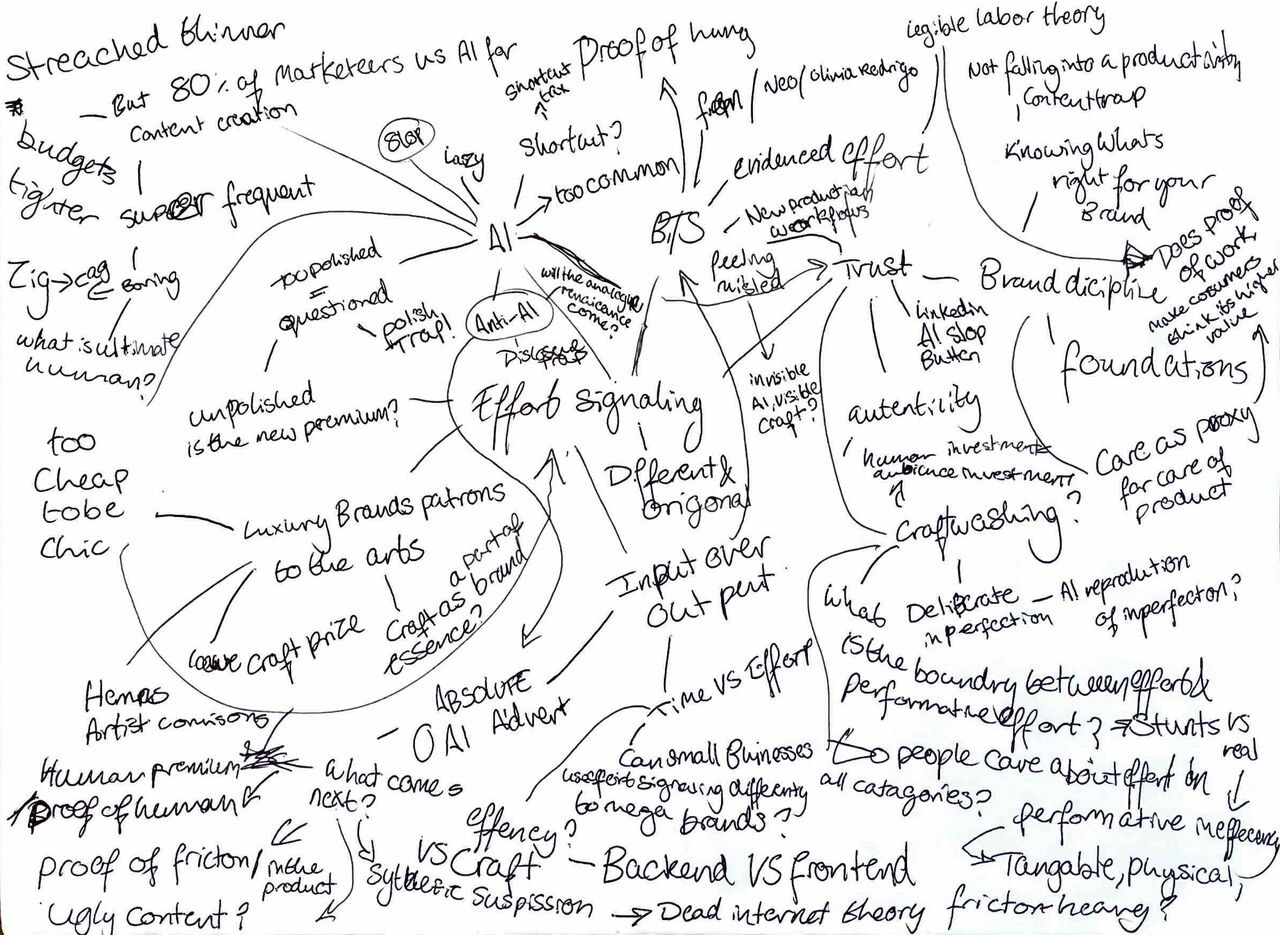
If reach stops meaning much when everything is polished but not brand distinct, what should we be measuring instead? Should it be saves, dwell time, the quality of the comments, the kind of interactions?
When the pace of the world, AI and efficiency makes everything instant, does the slow, friction heavy route, become the ultimate flex? I think it does. Let’s start to show your working.
Consumers have no idea what they're looking at. I can show my process but it won't matter bc they are not creators. They are Consumers. They don't trust polished work anymore? Then this is a race to the bottom that they will complain about, too.