

At some point over the last year, we’d had enough. We’ve gotten sick of diligently tracking our sleep hygiene on shiny titanium smart rings, and downloading clean minimalist apps to tell us how to inhale air for four seconds and exhale it for six. We optimised our mornings, our macros, and our calendars.
And for what? To be chronically inflamed, feeling every cortisol spike, priced out of housing, and staring at screens for eleven hours a day?
No thanks.
I think the cultural pendulum is swinging from tech optimisation, and clean scientific data, over to myth, ritual, and esoteric coping mechanisms. I can see how culturally Gen Z are sliding down what I am calling, the “Enchantment Funnel”, a slow slide from self-optimisation mindfulness hacks down into spiritual surrender.
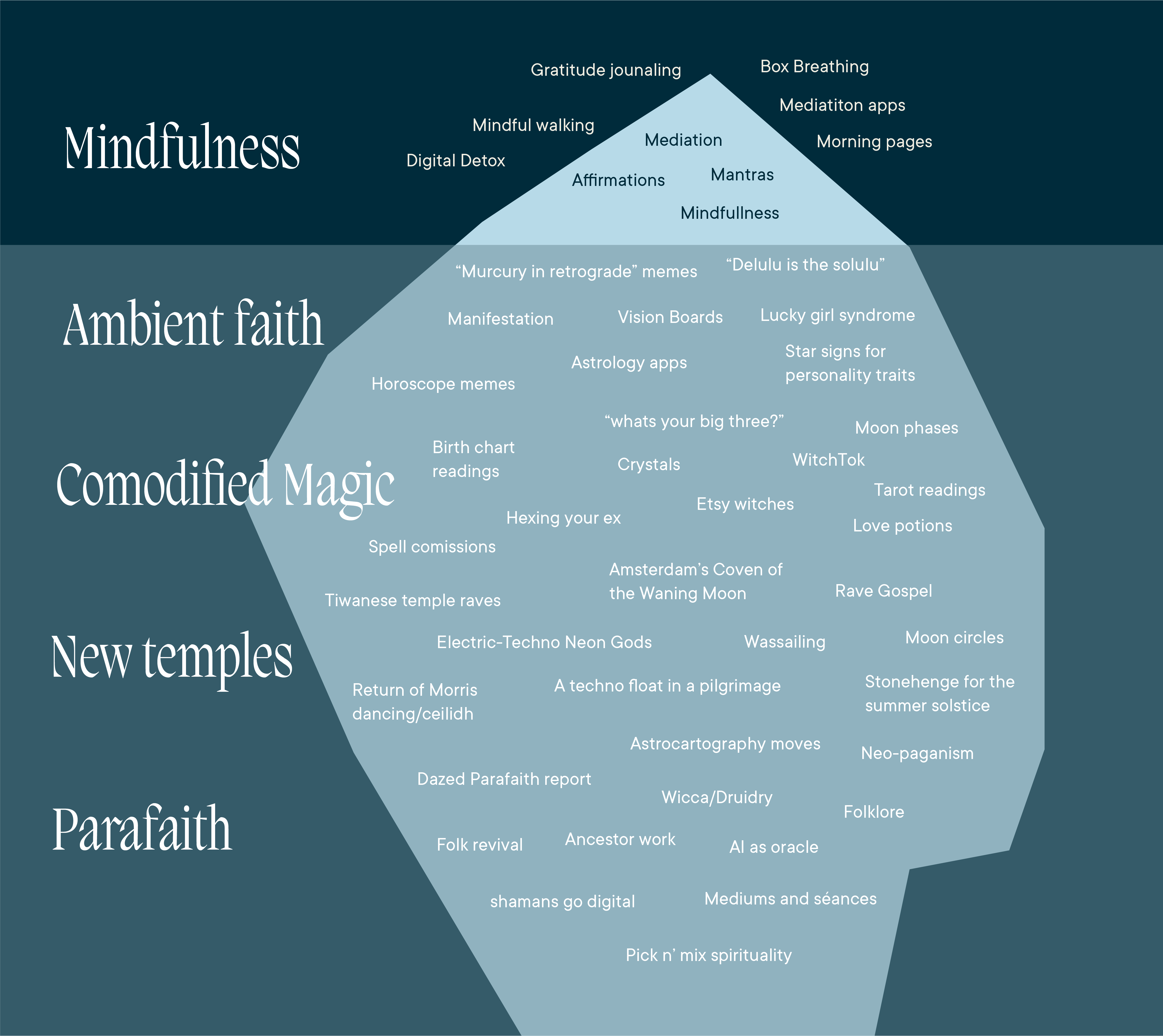
The Entry Point: From Mindful Optimisation to Ambient Faith
Do you remember the early millennial era? It was smugly secular, militant in its Richard Dawkins-style atheism, and fiercely loyal to bullet journals and calendar blocks.
Gen Z are marinated in that worldview’s aftermath. They grew up in the shadow of the 2008 crash, entered adulthood through a pandemic, and have watched the economic promises made to them fall apart. According to Gallup’s historical tracking of institutional confidence, faith in core pillars like banks, medical systems, and government has collapsed to historic lows in 2026. With nothing solid left to believe in, they went looking elsewhere for belief.
It didn’t go far. LADbible’s Youth Census 2025, a survey of more than 6,500 UK Gen Zs, found that 59% identify with religion or spirituality, 43% pray, 28% manifest, 27% meditate and 14% follow astrology. They are routinely blending these spiritual aspects to navigate life decisions and career dread.
Mindfulness is where a lot of people start. Meditation apps and breathwork sell the practice as a productivity tool, just sit still, breathe, and you’ll get more done, but the step from there to manifesting is tiny. Both ask you to sit quietly and focus your thoughts. Mindfulness says “your thoughts shape how you feel”, manifesting simply says “your thoughts shape what happens to you”. When white-knuckling your way through life with another habit tracker feels borderline delusional, manifesting starts to make a strange kind of sense.
In 2023 “Delulu is the solulu” was a popular meme, but at its roots, it was manifestation stripped of its yogic veneer, “I’ll succeed because I’m unhinged enough to believe the universe has my back”. It’s what traditional yogic philosophy calls radical surrender, (Ishvara Pranidhana) releasing the ego’s exhausting obsession with controlling the outcome and placing total trust in the cosmic infinite.
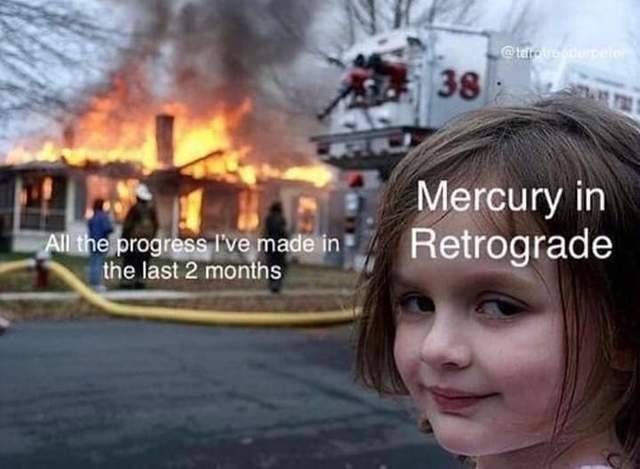
At this stage of the funnel, spirituality acts as culturally sanctioned permission to stop optimising. “Mercury is in retrograde” is an agreed-upon societal hall pass to log off, forgive your blown deadlines, and nurse your burnout.
If rest or reflection is genuinely part of what you offer, in order to tap into the market here, brands should stop positioning their product as a way to “hack” 30 more productive minutes out of the day. Sell deceleration. Give your audience explicit cultural permission to surrender, rest, and exist outside of hustle culture.
Commodified Magic & The £439 Consultation
As I was researching this article, a colleague recently pulled up the profile of an instagram witch charging £439 for an hour-long spiritual consultation. Their immediate reaction was “God, I kind of want to pay her just to tell me what to do with my life.”
Further down the funnel, memes give way to purchasing, and in Britain that makes sense. Across England and Wales alone, the Census recorded over 22 million people ticking “No Religion”. At the same time, the UK has roughly one million young people classified as NEETs (not in education, employment, or training) an entire cohort stranded outside traditional career ladders, priced out of basic milestones, and navigating economic crunch.
When you have millions of officially “secular” youth who have discarded the church, paired with nearly a million young people who are struggling to find their feet in a tough economy, you get an unprecedented vacuum of guidance. People don’t just want a job board or another generic career coach on LinkedIn, they desperately need someone to look them in the eye and tell them to have faith, that their next move will work out.
When traditional therapy costs £120 an hour and has six-month waitlists, paying for a cord-cutting ritual, an Etsy hex for your ex, or an astrological life consult is actually fairly reasonable, it’s like buying psychological safety, closure, and guidance in an economy that offers none.
This dynamic is pushing physical retail and consumer goods from commodities into being treated as talismans:
Flamingo Estate’s “Everyday Alchemy” capsule (tied to Practical Magic 2) sold out tools for everyday ritual transformation: mandrake candles, field protection flower essences, and apothecary bars formulated with mugwort and fennel.
In Oaxaca, luxury fragrance house Xinú built their flagship store to evoke a stone temple and ceremonial altar.
Tarot coffee concepts like Forchewn, which gives you a read on your future with every tea bag.


If your product already plays a role in people’s rituals, let the brand push harder into the emotional state your product protects or restores. It would also be worth considering whether a ritual calendar would be more resonant to tap into, than a promotional one.
New Temples & Sacred Nightlife
The trouble with a fully secular society, is that the church used to provide weekly civic infrastructure that forced people to sit together in a room, sing collectively, and experience shared awe.
Take that away and you can get lonely young people. The ONS has found that 16 to 24-year-olds feel lonely more often than any other age group, and the sticky-floored 2am club isn’t filling the gap. (I spoke about this in a previous article about the new third space.)
In its place is a desperate search for modern equivalents of collective effervescence, spaces that provide the catharsis and kinship of a congregation without the dogma. Some examples of this happening worldwide include...
Ecstatic dance, a sober, DJ-led dance party, is spreading across the UK, sometimes in deconsecrated churches.
Moon circles are becoming a fixture of city life. The Witches of Walthamstow have held new moon circles in East London since 2020, with sound healing, crystal singing bowls and intention setting , while the London Woodland Witches hold a monthly full-moon Wicca circle on the banks of the Thames.
Beltane Fire Festival is a pagan fire ritual revived in Edinburgh in 1988. Around 12,000 people climb Calton Hill for it, it relies heavily on students and young people, and nearly 80% of the audience are first-timers.
Temple Meltdown throws raves in Taiwan’s temples. Framing a party as a celebration for the gods gets around strict licensing rules, and temple elders, worried that young people are abandoning these spaces, welcome them in.
People don’t want another hollow networking mixer or a boozy corporate open-bar event. They want communion. As a brand, I think if you host an activation, build it around a collective action rather than passive observation. Shared listening, tea rituals, or sound journeys build ten times the emotional memory of a free spritz and a neon photo-op.
Parafaith
At the bottom of the funnel sits what Dazed Studio documented in their Parafaith Report, a modular, “pick n’ mix” belief system where youth culture pieces together ancestral folk traditions, pop-cultural fandom, internet esotericism, and ancient pagan roots into a makeshift spiritual framework.
This is where brands should stop or be incredibly careful about engaging. At this depth, belief can’t be sold as a purchase because it’s people’s identity. Brands can build the spaces and objects people use along the way, but they shouldn’t try to be the faith.
The Takeaway
Your role as a brand is not to tell people what to believe. Your role is to provide the grounded, physical infrastructure, the sensory shelter, or the communal spaces, that allows them to figure it out for themselves.
So, rather than asking “how do we jump on this/how can we work this into our marketing plan?”, ask whether there’s something exciting in ritual, mindfulness, magic or connection that aligns with your brand. If there is, that’s a real opportunity! Look at the four threads running through the funnel.
Ritual. Do you have rhythms, seasons or repeat moments your audience could build into their lives?
Mindfulness. Does your product genuinely help people slow down, rest or come back to themselves?
Magic. Is there wonder, transformation, awe, or alchemy in what you make or how you make it?
Connection. Do you bring people together, or could you?
If none of those threads fit? Leave it. If a cultural movement doesn’t align with your brand and you try it anyway, customers will know. Not every trend is for every brand.
The era of selling hyper-optimisation is losing ground to slower intentional living. The consumer is exhausted, unmoored and intuitively searching for enchantment. The brands that earn their devotion over the next decade will be the ones with a real reason to be there, creating spaces, objects and rituals that feel like a kind of faith.